5 Answers Your AI Chatbot Got Wrong About Your Own Schedule
A general-purpose AI chatbot will happily discuss your project schedule. It will name your critical path, quote float values, and assess your finish date — fluently, confidently, and without ever having run a single scheduling calculation.
Here are the five wrong answers we see most often, and the test that exposes each one in under a minute.
1. A critical path that changes every time you ask
A chatbot doesn't compute the critical path; it predicts what a critical path answer sounds like, from whatever part of your file it happened to read. Ask twice and the "critical" activities differ. Ask for the count and it changes again.
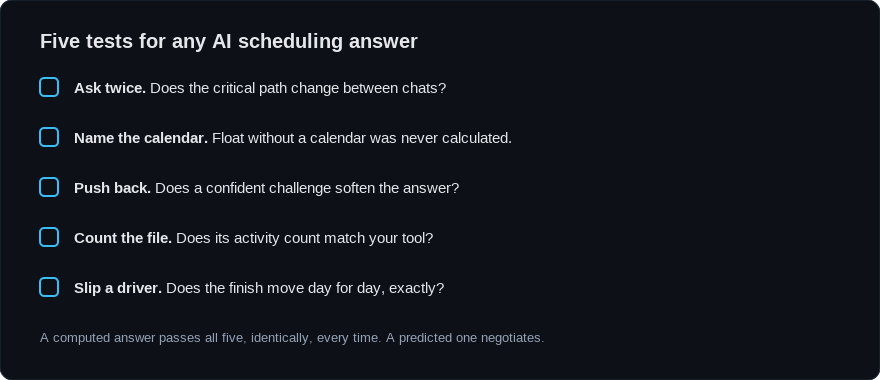
The test: ask for the critical path, then ask how many critical activities there are, then ask again in a new chat. A computed answer is identical every time. A predicted one wanders.
2. Float that ignores your calendar
Float lives in working days, and working days depend on the project calendar — a Sun–Thu week and a Mon–Fri week produce different float for the same network. A chatbot quoting float from a file it skimmed is doing arithmetic without the calendar, when it does arithmetic at all.
The test: pick one activity and ask for its total float, then ask what calendar that float assumes. If it can't name the calendar, the number was never calculated.
3. It agrees with your pushback
Tell a chatbot "that can't be right, procurement confirmed we're fine" and watch the assessment soften. It has no computed position to defend, so your confidence becomes its evidence. In a progress meeting, that's the most expensive failure mode of all: the tool validates whoever pushed hardest.
The test: challenge any answer with a confident, false claim about your own schedule. A tool with an engine underneath restates the number and shows why. A chatbot negotiates.
4. It answers about part of your file as if it were the whole
Large schedule files exceed what a chatbot reads in one pass. It sees a sample — sometimes a small one — and answers in the grammar of total knowledge: "the project finishes on…", "there are no overdue activities…". The counts it gives are counts of what it saw.
The test: ask how many activities the file contains, and compare with your scheduling tool. If the numbers differ, every other answer was about the sample too.
5. A finish date that doesn't move when the logic does
In a real network, delay a driving activity and the finish date moves — day for day, through the links. Ask a chatbot "what if this delivery slips two weeks?" and it will often agree the finish slips… by a number it invented, or reassure you the float absorbs it, without tracing a single predecessor chain.
The test: pick a task you know is on the driving path, ask what a five-day slip does to the finish, and check the answer against your scheduling tool. The engine's answer is boring and exact. The chatbot's is a story.
The pattern underneath
None of these are the chatbot "lying". It is doing what it was built to do — produce the most plausible next words. Scheduling answers are not a writing task. They are the output of a forward and backward pass over your actual network, your actual calendar, your actual progress. Any tool that skips the calculation is guessing with good grammar.
That's why we built ScheduleChat the other way round: a real CPM engine computes every date, float and count from your file, and the AI only handles the conversation around those numbers. Ask it the five tests above — the answers are the same on Tuesday as on Friday, because they were never opinions.
ScheduleChat is opening to planners in small batches. Join the waitlist and we'll email you when your spot is ready.
Related: I asked ChatGPT to run my critical path. It invented one.