Your Schedule Has 299 Broken Links. Your Software Never Told You.
Open a large schedule in MS Project or Primavera P6 and everything looks fine. The bars line up. The critical path glows red. The finish date sits there, confident.
What neither tool tells you is how much of that network is actually connected.
We ran a logic-health check over a real programme — 4,694 tasks, nine pump lines, 3,577 working activities once summaries and inactive tasks are excluded. The file had been reviewed, issued and progressed. It also had:
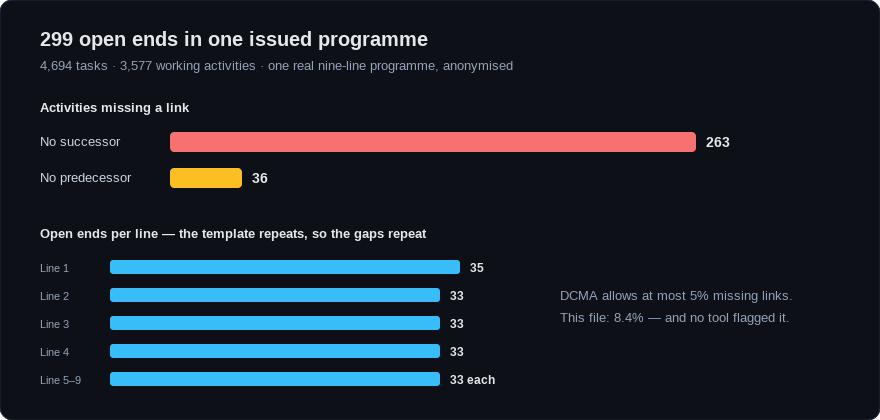
- 299 activities with a missing link — 36 with no predecessor, 263 with no successor
- 649 redundant links — relationships already implied by another path through the network
- 9 leads — negative lag, including one pair of activities carrying −45 days on every line
Nobody hid this. The software simply never counted it.
What an open end actually costs you
An activity with no successor drives nothing. It can slip a month and the project finish will not move — not because the work doesn't matter, but because the network doesn't know it matters. Its float is not large; it is meaningless. When someone finally notices the delay, it arrives as a surprise, and surprises in a progress meeting are expensive.
An activity with no predecessor starts whenever someone remembers it. Nothing in the logic holds it in sequence, so nothing warns you when its start drifts. It is a task the schedule describes but does not schedule.
Redundant links are quieter damage. Every duplicate path is one more relationship to maintain, and when the logic changes — a resequencing, a split delivery — the redundant link keeps enforcing the old plan. Reviewers stop trusting the network, and once planners stop trusting the logic, they stop reading the float. That is how a schedule becomes a picture of a plan instead of the plan.
The DCMA 14-point assessment, the schedule-quality standard used on major programmes, allows at most 5% of activities to be missing a predecessor or successor. This file sat at 8.4% — 299 of 3,577. Not catastrophic. Also not visible anywhere in the tool that produced the file.
The pattern repeats per line
The programme was nine near-identical lines, and the gaps repeated with them: 35 open ends on the first line, 33 on each of the other eight. That repetition is the tell. These were not random omissions by a careless planner — they were baked into the template every line was copied from. Fix the template's logic once and 299 problems become a handful.
It is also why a one-off manual audit doesn't hold. The next revision, the next copied line, the next "just link it to the milestone for now" quietly reintroduces them.
How to find yours
You do not need new software to get a first count — you need four questions your current tool won't ask for you:
- Which activities have no predecessor? Which have no successor? (Filter for them; in a healthy network the answer is a short, explainable list — the start and finish milestones and very little else.)
- Which links are redundant — already implied by another path? These are the ones safe to question first.
- Where is negative lag hiding? A −45d lead is not a rounding choice; it is a decision somebody made and the file forgot to explain.
- Do the counts repeat per section or per line? Repetition points at the template, not the planner.
If the counts surprise you, you are in the majority. The tools were built to calculate dates, not to grade the logic those dates stand on.
What we built for this
ScheduleChat runs this check on every import — open ends, redundant links, leads and lags, summary-task links, hard constraints — and keeps the results in the project's memory, so you can ask "are the links in this schedule logical?" or "which activities are missing a predecessor?" and get the actual list, with names, instead of a percentage. The same pack feeds the DCMA 14-point checks, so the quality of the logic is stated alongside any answer that depends on it.
Your finish date is only as honest as the network underneath it. Count the broken links before your client does.
ScheduleChat is opening to planners in small batches. Join the waitlist and we'll email you when your spot is ready.
Related: the MS Project setting that's been lying to you about your critical path